As a general rule, the stock quantity should not be negative. You cannot physically ship products that are not in inventory.
In practice, however, it can happen that a sale or shipment is booked before the related purchase has been received or booked. In these cases, the product can go into negative stock quantity.
When a product goes into negative stock quantity, the value of the negative inventory transaction is calculated based on the setting selected in Rackbeat.
Table of contents
This article is only relevant for Rackbeat agreements that use the Average cost price cost price principle.
If you use FIFO, negative value is always calculated based on the product’s Cost price.
Choose how negative value is calculated
When your stock quantity goes negative, you can choose between 2 ways of calculating the negative value:
- Negative quantity must be calculated as 0 value
- Negative quantity must be calculated based on expected cost price
This choice can only be made once. Once the setting has been selected, it is locked and cannot be changed later.
How to choose how negative value is calculated:
-
Hover over your name in the top right corner.
-
Click “Company settings”.
-
Go to “General settings”.
-
Click the “Accounting” tab.
-
Find the setting “Value of negative quantity”.
-
Select the calculation method you want to use.
How is negative value calculated?
When a product has a negative stock quantity, Rackbeat can calculate the value of the negative inventory in different ways.
The setting determines which value is used for negative inventory transactions. This may be relevant, for example, if products are sold or shipped before they are registered in inventory.
Negative quantity is calculated with DKK 0 in value
-
If this setting is selected, negative stock quantities are always calculated with a value of DKK 0.
-
This means that previous cost prices for the product are not used to calculate the value of the negative inventory.
-
Even if the product has previously had a cost price, both the negative inventory value and the value of the negative transaction will be set to DKK 0.
Example:
You sell trousers and currently have 0 pcs. in inventory.
A sale and a shipment are then created in advance, adjusting the stock quantity to -2 pcs.
Because negative quantities are calculated with 0 value, the result is:
| Stock quantity | Calculated value per pc. | Total negative inventory value |
|---|---|---|
| -2 pcs. | DKK 500 | DKK 0 |
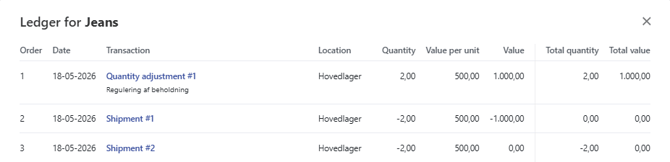
The transaction will therefore also have a value of DKK 0.
This means that the inventory can show a negative quantity, but the inventory value will not be affected negatively.
When the product goes from positive stock quantity to negative
If the product has a positive stock quantity, but more products are sold than are available in inventory, Rackbeat will calculate the value in two parts.
The part of the sale covered by the existing stock quantity is calculated based on the product’s actual cost price.
The part of the sale that goes into negative stock quantity is calculated with DKK 0 in value.
You have the following stock quantity:
- Stock quantity: 2 pcs.
- Cost price per pc.: DKK 500
4 pcs. are then sold.
The first 2 pcs. are calculated based on the actual cost price of DKK 500 per pc.
The remaining 2 pcs. go into negative stock quantity and are therefore calculated with DKK 0 in value.
| Quantity | Calculation | Transaction value |
|---|---|---|
| -2 pcs. | 2 × DKK 500 | -DKK 1,000 |
| -2 pcs. | 2 × DKK 0 | DKK 0 |
| -4 pcs. | -DKK 1,000 |
After the sale, the stock quantity is -2 pcs., but the transaction value is only -DKK 1,000, because the negative part of the sale is calculated with DKK 0 in value.

Negative quantity is calculated based on expected cost price
-
If this setting is selected, negative stock quantities are always calculated based on the expected cost price.
This means that the expected cost price is used to calculate the value of the negative inventory. The value of the negative inventory transaction will therefore correspond to the negative quantity multiplied by the expected cost price.
Example:
You sell trousers and currently have 0 pcs. in inventory.
The product’s expected cost price is DKK 500 per pc.
A sale and a shipment are then created in advance, adjusting the stock quantity to -2 pcs.
Because negative quantities are calculated using the expected cost price, the result is:
| Stock quantity | Calculated value per pc. | Total negative inventory value |
|---|---|---|
| -2 pcs. | DKK 500 | -DKK 1,000.00 |
The transaction will therefore also have a value of -DKK 1,000.00.
When the product goes from positive stock quantity to negative
If the product has a positive stock quantity, but more products are sold than are available in inventory, Rackbeat calculates the value in two parts.
The part of the sale covered by the existing stock quantity is calculated based on the product’s actual cost price.
The part of the sale that goes into negative stock quantity is calculated based on the product’s expected cost price.
Example
You have 2 pcs. in inventory with an actual cost price of DKK 600 per pc.
The product’s expected cost price is DKK 500 per pc.
4 pcs. are then sold.
The first 2 pcs. are calculated based on the actual cost price of DKK 600 per pc.
The remaining 2 pcs. go into negative stock quantity and are therefore calculated based on the expected cost price of DKK 500 per pc.
| Quantity | Calculation | Transaction value |
|---|---|---|
| -2 pcs. | 2 × DKK 600 | -DKK 1,200 |
| -2 pcs. | 2 × DKK 500 | -DKK 1,000 |
| -2 pcs. | -DKK 1,000 |

Because negative stock quantity often occurs when the supplier invoice can only be booked retrospectively after a sale, you can expect corrections to occur in these cases when the purchase is booked. |
Correction of negative value
This section is only relevant if you have selected: “Negative quantity must be calculated based on expected cost price”
When the value of an inventory transaction changes after booking, Rackbeat can automatically make a correction.
This typically happens if an inventory movement is booked with a date before an already booked transaction. For example, this could be a purchase booked with a date before a shipment that had previously sent the product into negative stock quantity.
When this happens, the value of the negative transaction is recalculated based on the new cost price.
Rackbeat therefore corrects both the value of the negative transaction and the subsequent inventory value.
Example:
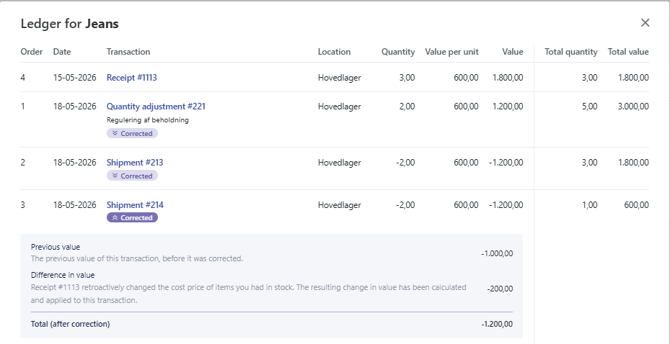
Using the same starting point as before, we have a negative transaction of -2 pcs.
The expected cost price was DKK 500 per pc., and the negative transaction therefore had a value of:
-
Stock quantity: -2 pcs.
-
Expected cost price per pc.: DKK 500
-
Transaction value: -DKK 1,000
A purchase is then booked with a date before the shipment.
The purchase consists of:
-
Quantity: 3 pcs.
-
Actual cost price per pc.: DKK 600
-
Total value: DKK 1,800
Because the purchase is booked before the shipment, Rackbeat now has a new cost price to calculate from.
The negative transaction is therefore corrected from DKK 500 per pc. to DKK 600 per pc.
The corrected transaction becomes:
-
Stock quantity: -2 pcs.
-
Corrected cost price per pc.: DKK 600
-
Corrected transaction value: -DKK 1,200
After the correction, the inventory is left with:
- Stock quantity: 1 pc.
- Inventory value: DKK 600
The correction ensures that the inventory value is updated retroactively based on the actual booked cost price.
This way, you can ensure a correct inventory value by booking the transactions in the correct order, where the purchase is dated before the sale or shipment.